 由 admin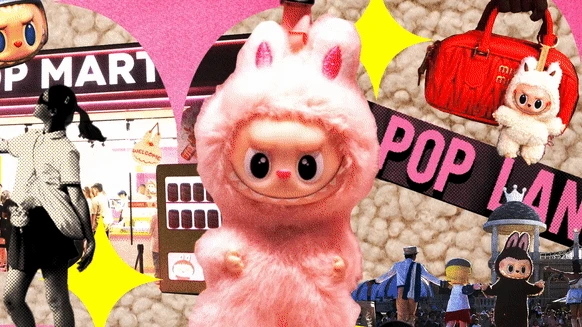
The Global Phenomenon of Labubu: Pop Mart’s Rise to Prominence
I. The Allure and Scarcity of Labubu
Two young women hunker down beside a low – lying wooden display teeming with Labubus. They pose to each other the very query that occupies my mind: Which of these plush collectibles will the Pop Mart toy company bestow upon me the honor of taking home today? Will it be the 16 – inch – tall Labubu donning denim overalls and a fisherman’s hat, or the keychain Labubu with vibrant fur and somewhat possessed eyes? Might I be fortunate enough to acquire both?
The clerk at this Beijing store – Pop Mart’s inaugural outlet – offers a dose of reality. “None of these items are in stock,” she states brusquely. “You can join our fan group chat and await the restocking alert.”
Indeed, Labubu is far more than a mere creepy – cute stuffed hybrid of a rabbit, demon, elf, and bear. Labubu has graced the front row at Milan Fashion Week. Tourists queued up at the Louvre to purchase a Labubu from the pop – up store. Lady Gaga has donned a Labubu – inspired costume during a concert, and Madonna served Labubu – themed cake at her birthday. In London, when Labubu sold out, customers resorted to brawling. In Thailand, where Labubu serves as the government’s official tourism ambassador, trendy party – goers even purchase Labubu – shaped ecstasy pills. Even knockoff versions, known as Lafufus, have amassed their own loyal following. One cannot expect to simply walk out of the store with this social currency; it must be earned.
II. The Quest to Obtain Labubu
Around the globe, Pop Mart employees uniformly advise starting by closely monitoring the company’s social media feeds for news and alerts. In China, an additional option presents itself: scanning a QR code to join a dedicated WeChat group. The one I joined is named “Pop Mart Beijing First Store Group No. 35.”
A rapid, disheartening calculation reveals that my group is capped at 200 members. Assuming 34 other groups filled up prior, at least 7,000 eager fans are vying to buy a Labubu. And this is just at this single store, out of the more than 400 that Pop Mart operates in China. When the restock alert arrives, we must hit the purchase button with the speed of a hummingbird’s wing – beats.
One morning at 10:57 am, news breaks in the chat: A pink plushie keychain priced at 100 RMB (approximately $14) will be restocked in three minutes. When the time arrives, the group is filled with disappointment. Only one person announces that she has secured the keychain. Soon, others begin inquiring if she will resell it, and an auction ensues. “I’m not selling,” the fortunate buyer writes, yet the bidding persists. In less than a minute, it reaches 900 RMB ($126). When she fails to respond again, the group reverts to lamenting the difficulty of purchasing a Labubu from Pop Mart at the original price.
III. The Surprising Global Adoption of Pop Mart’s Tastes
Many in China, even long – time Pop Mart enthusiasts, have been taken aback by the sudden global embrace of their tastes this year. Amber Zhang, a partner and analyst at a Beijing – based data intelligence company, confesses that she once seriously contemplated shorting Pop Mart’s stock, as she simply could not fathom why both consumers and markets were going wild over a plushie doll. However, she changed her stance. “At this juncture, it’s no longer about my objective or subjective assessment of its quality,” Zhang remarks. “There is, in fact, a global social consensus that this is popular, this is a hit.”
In the first half of 2025, the Labubu craze propelled Pop Mart’s global revenue to grow by over 200 percent. It is now valued at $46 billion – ranking just below Disney and Nintendo in the same industry and exceeding the combined value of the makers of Transformers, Barbie, and Hello Kitty. Outside of China’s electronics and software powerhouses, few Chinese consumer brands have achieved such remarkable global success.
Where Western buyers perusing Shein, Temu, or Amazon may associate “Made in China” with an abundance of cheap imitations, on a Pop Mart product, it connotes something novel: a homegrown cultural phenomenon that is globally idolized, perhaps due to – or in spite of – its relative inaccessibility. Coinciding with China’s significant tourism push and a more positive global perception of the country, Labubu has become an inadvertent symbol of China’s burgeoning soft power, even if Pop Mart prefers to distance itself from geopolitics.
IV. An In – Depth Exploration of Labubu
This summer, I embarked on an international journey to delve beneath Labubu’s grinning exterior and understand the squishy polyester stuffing within. I visited Pop Mart stores in four countries, interviewed a company executive, dined at a Labubu – themed café, witnessed human – sized Labubus engaged in combat before an audience, and conversed with long – time fans about their experiences within the fandom. I encountered countless Labubus, both genuine and counterfeit, fuzzy and smooth, adorning purses and perched on shoulders. While my initial interest was purely journalistic, by the end, I had spent hundreds of non – reimbursable dollars on Labubus of my own – and had grown closer to comprehending how millions of people, seemingly out of nowhere, had fallen in love with a mischievous rabbit – eared monster.
V. Pop Mart’s Founding and Evolution
Wang Ning, Pop Mart’s 38 – year – old founder, was instilled with the entrepreneurial spirit from a young age. His parents were small – town shopkeepers, selling everything from cassette tapes to fishing rods. By the time Wang graduated from college, he had already operated a documentary studio, managed a budget hotel, and bulk – purchased holiday – themed glowing hairbands for Christmas sales. Hours after receiving his diploma, he boarded a train to Beijing. The following year, in 2010, he opened the very first Pop Mart store in a shopping mall in northwest Beijing. He personally wired the lights, hung the shelves, and arranged the furniture.
In “A Company One of a Kind,” a Chinese – language corporate biography of Wang and Pop Mart, the founder discusses designing his stores to evoke a sense of worship (albeit more Instagram – friendly). That is precisely what the original Pop Mart store had become when I visited this year and “knelt” at the altar of Labubu. Initially, however, that first store sold a random assortment of trendy gadgets, clothes, and toys – whatever was considered cool by young people at the time. (This is how it earned its name.) In fact, before reporting this story, I had not realized that I likely visited the store in its early years. I attended college nearby, and that mall was my regular weekend haunt. I probably passed by it hundreds of times and entered occasionally. I suppose I had not found it particularly memorable. Nevertheless, the business of chasing trends was lucrative enough for Pop Mart to expand to two dozen stores within its first five years.
In 2015, Wang persuaded Si De, a classmate from his MBA program, to join his startup. (Si later became the company’s chief operating officer.) That year, they noticed that nearly a third of the revenue in some stores originated from a single product – Sonny Angels, Japanese collectible figurines resembling naked angels in various headgear. These 3 – inch mini – figures are still sold in “blind boxes” today, meaning different figures are placed in identical packaging, and buyers do not know which one they have until they open it. Wang and Si aimed for Pop Mart to become Sonny Angels’ exclusive Chinese distributor. The Japanese company declined, stating in an email that they should part ways.
For the first time, Wang and Si considered transforming Pop Mart into a brand that manufactures Sonny Angel – like products with the company’s own character designs, known in the industry as intellectual properties. They discovered Kenny Wong, an emerging toy designer based in Hong Kong, best known for creating Molly, a little girl doll with a blond bob and pursed lips. In 2016, they signed an agreement for Pop Mart to mass – produce Molly figurines. “Our first contract with Kenny was handwritten by Kenny and me,” Si recalled in an exclusive interview with WIRED. He and Wong would later laugh about the unprofessional nature of that contract.
VI. The Blind – Box Concept and Labubu’s Origins
Pop Mart took the blind – box concept and expanded upon it, establishing unique rituals to heighten the excitement. When selecting a box in the store, a buyer may lift it to gauge its weight and shake it to hear the sound, but may not press the box to feel the toy’s edges, pry open the gaps to peek inside, or place it on a scale. Devotees of the blind box have their own jargon. The unattractive and unwanted results are called leikuan (heinous item), the adored ones are rekuan (hot item), and the rarest prize, yincangkuan (hidden item), is found only once in every 72 to 720 boxes, depending on the product.
Pop Mart’s bet on Molly and blind boxes paid off, and the company continued to contract with new designers. In interviews at the time, Wang often compared Pop Mart’s strategy to that of a record label – constantly scouting for the next big talent.
Labubu originated as a background character in a children’s book titled “The Story of Puca,” set in a dark, mythical forest. The story centers around Puca, a fairy, and the forest’s other inhabitants – including 100 cat – sized elves with rabbit ears and pointy nine – toothed smiles. The book’s author, Kasing Lung, named the species “Labubu” after an internet search revealed the name was unclaimed.
Lung had been doodling Labubu – like creatures for much of his life. Born in Hong Kong in 1972, he moved to the Netherlands at the age of 6 due to his parents’ ownership of a Chinese restaurant there. Unable to speak Dutch, a teacher provided him with picture books containing fewer words. Lung spent countless hours at home, above the restaurant, silently reading the books and drawing. He has stated that European cartoon characters, such as the Smurfs from Belgium and Moomins from Finland, aided his assimilation. “The ones I like most are tales about spirits and fairies,” Lung writes in the epilogue to “The Story of Puca.” “They tend to carry a slightly eerie and unsettling atmosphere – something that both attracts and frightens me.”
Although Labubu was not the protagonist in the book, it was the first character to be transformed from 2D to 3D. Lung collaborated with Howard Lee, the founder of a Hong Kong toy studio called How2Work, to produce commemorative Labubu figurines for the book’s launch. “We ran out of time to spray – paint, and that’s why the first – ever Labubu was completely black,” Lee recalls. The two men brought 100 copies of “The Story of Puca” and 60 hand – painted Labubu figurines to a toy convention in Taipei in 2015. All of them sold out.
The “Monsters” franchise, as Lung refers to the collection of characters including Labubu, Puca, and other forest creatures, significantly advanced his career. In written responses to questions from WIRED, sent via Lee, the reclusive Lung states that he remembers meeting Pop Mart’s Wang at the same toy convention a few years later. “I chose Pop Mart because we shared many of the same creative values, which is quite rare,” Lung says. “They also had an excellent production team.” Even as Pop Mart operated dozens of stores in China, it was gearing up for overseas expansion. In 2019, Lung and Pop Mart initiated an exclusive contract to produce certain types of toys based on the “Monsters” IP.
VII. Labubu’s Transformation and Commercial Success
With Pop Mart’s assistance, Labubus evolved from hobby figurines for collectors to a vast array of mass – produced toys, stationery, and accessories. Labubu itself, as avid fans recall, has also undergone changes. Initially, most Labubu toys had square heads and exuded a more evil than cute appearance. The round – headed Labubu toys of today appear plump, fuzzy, and friendly.
The most significant transformation occurred in 2023, when Pop Mart introduced a groundbreaking product: plush keychains with faces and limbs crafted from vinyl. While this may not seem particularly innovative today, most of the toys sold by Pop Mart prior to this were either soft plushies with flattened facial features or hard vinyl dolls intended for display on tabletops. The plush – and – vinyl Labubu keychains quickly found a much wider audience. One by one, influential tastemakers – Lisa from Blackpink, Rihanna, Kim Kardashian, Marc Jacobs – were photographed wearing outfits accessorized with Labubu keychains. “We were very excited about it, but we truly did not anticipate it to be as viral as it is,” Si says. Lung says he is “both very happy and very surprised.”
By 2024, the “Monsters” franchise was generating approximately $425 million in annual global revenue – a seven – fold increase over the previous year. In the first six months of 2025, Pop Mart sold $670 million worth of Labubus, surpassing the sales of Barbie or Hotwheels during the same period. Collectors, too, have reaped financial rewards. In Beijing, a rare human – sized statue of Labubu in mint green, produced by How2Work in the early years, was recently auctioned for $150,000.
VIII. Supply, Demand, and the Resale Market
“It’s truly too popular,” Si says. “Everyone assumed we were engaged in scarcity marketing because most users couldn’t obtain one.” In fact, the company has significantly increased its plushie production capacity. In 2024, it could manufacture 3 million plush toys per month. Now, it can produce over 30 million, with a target of 50 million per month by the end of this year. In mid – June, the company began preselling Labubu plushies with delivery dates a month later to temper overheated demand while supply caught up. As a result, Labubu’s resale price dropped significantly.
Nonetheless, to acquire a Labubu keychain today, one typically needs to have some connection to a distributor, reside in a country with more supply, or simply be extremely lucky. Anna, a business analyst in Hong Kong, informed me that she was not a toy enthusiast but felt socially compelled to learn about Labubu and Pop Mart as she began seeing people in her life sporting one on their purses. This summer, she offered some friends in the US six new Labubus, freshly purchased from a store in Hong Kong where they were more readily available. Her friends eagerly snapped them up. “You already feel good when you see a Chinese IP being so widely accepted overseas,” she told me, citing Labubu’s virality as an example of the rising influence of Asian cultures. Additionally, “I have the access that they don’t have in America,” she said. “It becomes a symbol of social status.”
IX. Pop Land and the Resale Landscape
The day after my failed attempt to secure a Labubu from Pop Mart’s original store, I decided to console myself with a visit to Pop Land, the company’s 10 – acre theme park in central Beijing – perhaps the most telling indication of its aspiration to compete with Disney. (“Our art toys are like Disney’s movies,” Wang says in “A Company One of a Kind.” “They use movies to reach consumers, cultivate fans, and build IP and fan communities. We do it through art toys.”)
Pop Land is approximately 1 percent the size of Universal Studios in Beijing and Shanghai’s Disneyland. However, unlike other theme parks, it is located adjacent to the consulate district and a few subway stops away from Beijing’s most populous business areas. Situated in a city green space, Pop Mart was prohibited from moving even a single tree. Instead, the company renovated an abandoned building on the property and named it Molly’s Castle. A leafy area was transformed into Labubu Adventure Forest, though it appears much brighter and more child – friendly than Lung’s original portrayal. At one end of the forest, actors perform a “Warriors Training Camp” in full – size Labubu suits.
I stopped for lunch at the park’s restaurant, on the third floor of Molly’s Castle. The moment I was seated at a table and informed the waitress that I was dining alone, she placed a 23 – inch – tall plush doll in the chair opposite me. My dining companion was Zimomo, the male chief of the Labubu clan in the original children’s book and one of the rarest Pop Mart products available. Throughout my lunch, other Pop Land visitors continuously approached to inquire whether I had purchased the Zimomo doll myself and if they could take a picture of it. I felt as though I was dining with a celebrity.
At the table next to me was a mother and her young daughter. I asked what had brought them here. The mother told me that her daughter, who would turn 4 in less than a month, had discovered and fallen in love with Labubu through watching videos on Douyin, the Chinese version of TikTok. She had considered buying two Zimomo dolls for her daughter, but they cost $200 each on the resale market, so she was still undecided. Just the day before, she had seen on social media that a friend’s daughter had a Labubu – themed birthday party, where the room was filled with dozens of rare Labubus. She showed me videos of the party on her phone. “Her mom paid a fortune to acquire these,” she said.
Since commencing my own Labubu hunt, I was aware of the option to turn to a reseller, often referred to in China by the slang term huangniu (literally “yellow ox”). Dong, a Pop Mart customer since 2018 in Shanghai, informed me that many huangniu he knows utilize bots to monitor social media for restock announcements and snatch up new merchandise the moment it becomes available. Dong has paid a small fee to join group chats where huangniu release early information. He now refers to himself as a fenniu – somewhere between a fan and a huangniu. He has already amassed most of the Labubu products ever released, so he only buys new ones to sell to other fans for a profit. (Which, to me, seems like he is a huangniu.)
X. The Thai Connection and the Reselling Market
With due respect to Dong, it seemed improper to simply throw money at the problem and be done with it. So, I followed another piece of advice I received: go