 由 admin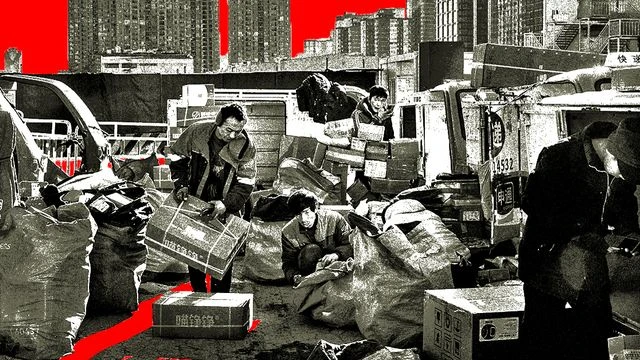
Insights from Hu Anyan: On Work, Culture, and Freedom
I. Introduction
In the newly translated English version of his best – selling book I Deliver Parcels in Beijing, Hu Anyan poignantly describes his arduous experiences: “Often, sweat was dripping down my back within the first two hours of a shift and would not stop dripping until the next morning. I sweated so much I never once needed to pee.” This passage resonated deeply as it was read during a sweltering summer in Tianjin, amidst an unprecedented annual heat wave that confined most indoors, except for the indefatigable couriers and delivery workers, whose services are in even higher demand in such extreme temperatures.
Hu Anyan first gained viral popularity in China five years ago and has since established himself as a prolific author. While books like Living in Low Places delve more into his inner life, I Deliver Parcels in Beijing offers a refreshing, on – the – ground account of nearly a decade of his work, set against the backdrop of China’s economic ascent. The book not only details his courier days in Beijing but also recounts his adventures in opening a small snack shop, working as a bicycle store clerk, and his brief stint as a Taobao seller. His minimalist, almost hypnotic prose uncovers the perverse beauty of unwavering endurance in an increasingly precarious economic landscape.
II. Cross – Cultural Perspectives on Work
When international audiences read about work in China, there is a tendency to exoticize it, as if only the Chinese are capable of working under mind – numbing conditions around the clock. Some of Hu’s earlier jobs, such as running an e – commerce shop during the “golden age of Taobao” or the intense parcel – sorting work, are indeed characteristic of China’s rapidly developing economy. However, elements like precarious employment, the distortion of work relationships due to profit pressures, and the mundane angst of labor are quite familiar to American readers. Hu’s straightforward writing style reveals the similarities between toiling in a logistics warehouse in Luoheng and Emeryville, including night shifts, post – work drinks, petty disputes, and stuffing items into polypropylene bags.
III. Hu Anyan’s Journey and Insights
A. Balancing Writing and Courier Work
Hu Anyan clarifies that his writing and logistics work did not occur concurrently. For instance, during his time delivering packages in Beijing or doing night – shift parcel sorting in Guangdong, he was neither writing nor reading. After work, he needed to decompress. The period in his book when he mentioned reading James Joyce’s Ulysses and Robert Musil’s The Man Without Qualities was a special case, as the company was in the final stages of ceasing operations, allowing him to finish deliveries early. Courier work typically requires a 7 am clock – in, and one must complete all deliveries and return remaining goods to the station before leaving. In contrast, 70 – 80% of food delivery workers in China are part – time, with no attendance requirements.
B. Fear of Robots Replacing Delivery Workers
Regarding the anxiety about robots replacing delivery people, Hu observes that in reality, there is relatively little concern among his colleagues. While jobs in video editing, advertising, and design may face such threats, physical labor like delivery is less likely to be automated. He also believes that the Chinese government will exercise more regulation than the US government to ensure that automation benefits people, as technology should improve people’s lives to be considered valuable.
C. Backgrounds of Colleagues in Courier Work
In night – shift logistics sorting, it is likely that none of the workers have a university education, as such jobs are often taken by those with limited alternatives. However, in courier work, there are individuals with higher education. At his previous station, out of eight people, two had junior college degrees. Hu notes from his experience that many Chinese college students struggle to find good jobs. College graduates may end up in basic entry – level positions with lower incomes than couriers and delivery workers.
D. Thoughts on “Tangping” (Lying Flat) Culture
Hu, born in the 1970s, attributes his work ethic to the education of his generation, which instilled a sense of duty and fear of criticism from superiors. During his time, China had a planned economy, and career planning was often unnecessary as schools assigned jobs for life. In contrast, the younger generation, born after 2000, has grown up in a more prosperous environment, with parents born in the 70s or 80s. They may not have experienced material scarcity, leading them to question the value of intense competition and overwork, giving rise to the “tangping” culture.
E. Freedom and Simple Living
Hu reflects on how jobs in his thirties and later consumed a significant amount of his time, leaving him with little sense of autonomy or value. For example, working at Foxconn, where one only performs a single, repetitive task, can make one feel like a mere tool. The freedom he discusses in his book is the pursuit of personal value outside of uncreative, dehumanizing work, such as creative pursuits. He also points out that a simple life can be conducive to freedom, as higher material pursuits require more time and energy invested in work, limiting one’s freedom.
This is an edition of Zeyi Yang and Louise Matsakis’ Made in China newsletter. Read previous newsletters here.